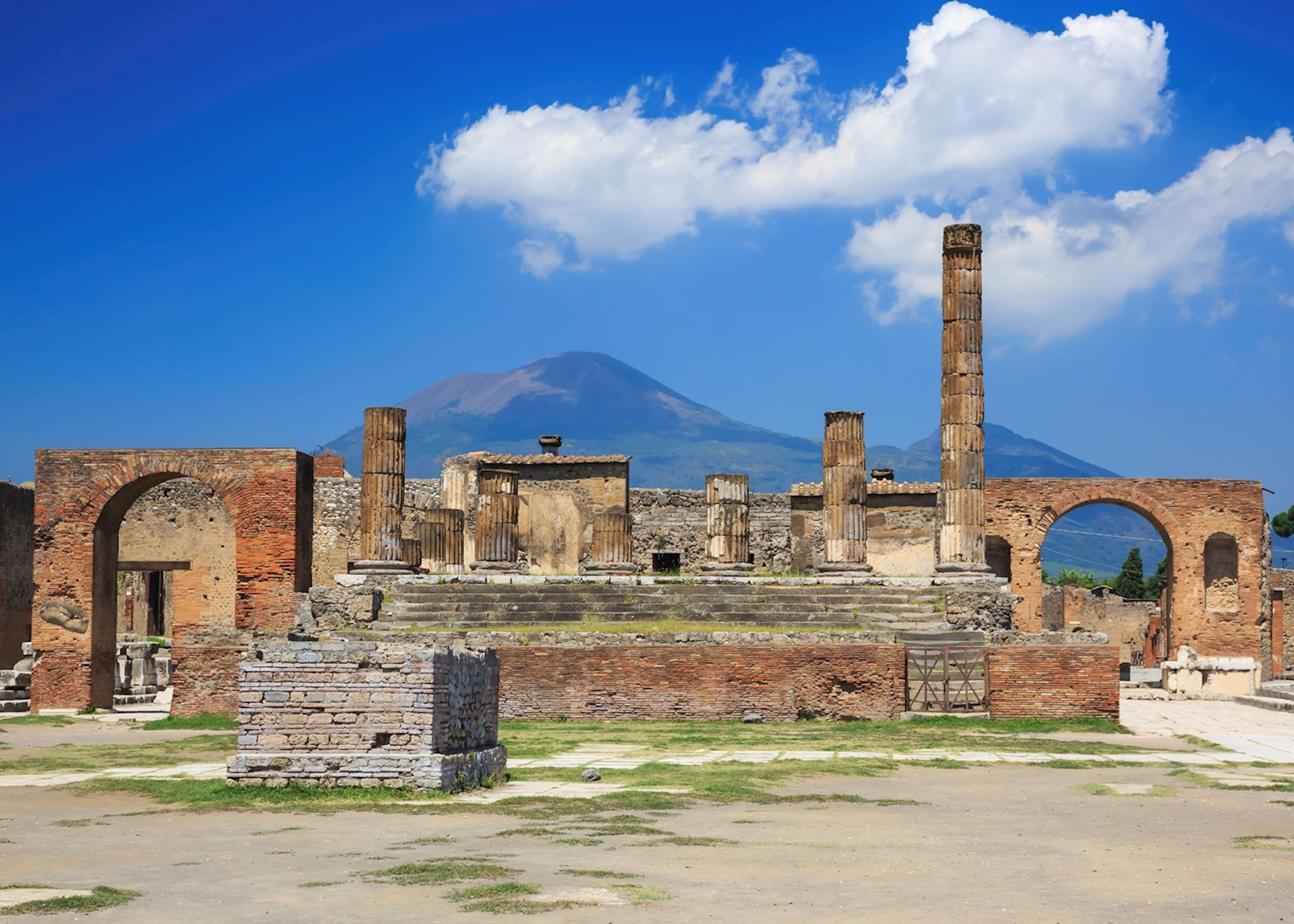
In the year 79 AD, the Roman city of Pompeii vanished under a mountain of hot ash in just twenty-four hours. A huge volcano named Mount Vesuvius blew its top and froze the entire town in time. Nobody saw the town again for more than sixteen hundred years.
The short answer to how it happened is simple. Heavy ash broke the roofs, trapped the people, and preserved every building under twenty feet of dirt. When workers dug a water canal in 1599, they touched the lost walls without knowing what lay beneath. Today, it stands as the most complete picture of ancient life ever found on Earth.
The Day Mount Vesuvius Stopped Time in Pompeii
The sun came up on August 24 in 79 AD like any other hot summer day. People in Pompeii were opening their shops, baking bread, and taking baths. They did not know the big mountain behind their homes was a volcano. They thought it was just a green hill covered in sheep and trees.
Around noon, the top of Mount Vesuvius blew open with a terrible noise. A black cloud of smoke and rock shot twenty miles up into the sky. It looked like a giant pine tree made of fire. Hot gray stone began to rain down on the streets at a rate of six tons every minute.
A teenager named Pliny the Younger watched the cloud from across the bay. He sat down and wrote what he saw on a sheet of paper. His letters are a great example of an ancient human-interest story recorded as events took place. He said the sea pulled back from the shore, and the sky went darker than any normal night.
People had to make a choice fast. Should they stay inside their homes or run into the dark streets? Some put pillows on their heads with strips of cloth to protect themselves from falling stones. Others held onto their bags of coins and key rings, hiding under stone stairs.
By the next morning, a terrible wave of hot gas and dust rushed down the mountain side at one hundred miles per hour. It was over seven hundred degrees inside that cloud. Anyone left in the city died in less than a second. The ash settled over the buildings like wet mud and turned hard as rock.

How Was the Buried Town Found Again?
For hundreds of years, people forgot the exact spot where Pompeii used to stand. Grass grew over the hard dirt, and farmers planted grape vines above the roofs. Locals called the empty field La Civita, which means The City, but no one knew why.
In 1599, a group of workers dug a deep ditch to move water from a nearby river to a paper mill. An architect named Domenico Fontana was in charge of the job. His tools struck hard stone deep in the dirt. He found thick walls painted with colorful pictures and words written in Latin.
Fontana did not keep digging. He covered the walls back up with dirt and went home. Some people think he felt shocked by the bright art on the walls. Others think he was just trying to finish his water pipe on time. Whatever his reason, the town stayed asleep for another hundred and fifty years.
Then, in 1748, a Spanish military engineer named Rocco Gioacchino de Alcubierre started digging to find old statues for the King of Naples. He brought picks, shovels, and fifty men to the green fields. This time, they did not stop digging when they hit stone.
On April 6, 1748, workers hit the ruins of a large hall. They cleared away the grey dirt and found coins, iron tools, and intact jars of wine. They quickly realized they were not just looking at a few old rocks. They had found the lost town of Pompeii.
What Did Diggers Find Under the Ash?
Digging up Pompeii was like opening a huge box that had been sealed two thousand years ago. The ash had kept out air and wetness. Because of that, things that usually rot away were still sitting right where owners left them.
In a baker's shop on a narrow street, diggers found eighty-one loaves of round bread still inside a stone oven. The top of the bread was dark, but you could still see the baker's mark stamped into the dough. Nearby, small wooden tables, bronze oil lamps, and glass bottles sat intact on shelves.
You can read about modern wild events on our blog, like when Celebrities Join Chaos at F1 LEGO Minicar Race in Las Vegas, but Pompeii shows us a different kind of sudden event. The city showed how regular ancient people actually lived their daily lives. Rich house walls were covered in bright red paint with pictures of garden birds and fruit trees.
Poorer shops had funny scribbles scratched onto their outdoor plaster walls. People wrote about local election fights, bad wine, and lost boots. One message on a wall said, "If you are going to fight, go home!" Another simply read, "We have survived!" right before the end came.
The streets still showed deep tracks worn into the stone by wood cart wheels. At street corners, raised stepping stones let people cross the road without stepping in muddy water. Public fountains were still worn smooth in spots where people rested their hands to take a quick drink.
The Famous Plaster Casts of the People Left Behind
The most shocking part of Pompeii was not the buildings or the gold. It was the empty spaces left under the dirt where human bodies had melted away over centuries. The hard ash held the exact shape of their clothes, shoes, and faces long after the skin and bones turned to dust.
In 1863, an Italian boss of the dig named Giuseppe Fiorelli thought of a smart trick. When his workers found a soft pocket in the hard dirt, they did not smash it. Instead, they mixed up liquid white plaster and poured it down into the small hole.
They waited a few hours for the white plaster to get hard, then carefully scraped the dirt away. Out came a perfect plaster statue of a real person in their final moment of life. It showed the folds of their clothes, the laces on their leather shoes, and the look on their faces.
One cast showed a small dog lying on its back, curled up with its paws in the air. The collar around its neck still had small iron rings attached to it. Another cast showed a father trying to lift his young child up onto a wall to save them from the dark dust.
Near a city gate, they found a man lying on his side with his hands over his mouth. He was trying not to breathe in the hot ash. Nearby, a mother held her tiny infant close to her chest under a fallen cape. These white plaster figures transformed Pompeii from an old heap of stones into a story about real human beings.
Why Is Pompeii Still Important Today?
Pompeii gives us a rare view of history that books cannot provide. Most ancient history tells us about kings, wars, and giant marble tombs. Pompeii tells us what regular cobblers, cooks, and kids did on a Tuesday morning.
Historians use the site to learn about ancient building work, food habits, and health issues. Scientists tested the teeth of the plaster cast people and found they had very strong teeth because they ate lots of fruits and no refined white sugar. They also learned basic survival skills failed against a blast of that size.
Today, millions of people walk down those old stone streets every year. You can see more great tales like this on The Daily Ripple blog homepage, where real history comes alive every day. It feels strange to stand in a kitchen where someone made lunch two thousand years ago.
Mount Vesuvius is still an active volcano today, sitting right beside the big city of Naples. Scientists watch it every hour of the day with smart sensors. They know the mountain will blow again one day, but now people have cars and radios to get out in time.
What Can We Learn From the Buried City?
The story of Pompeii reminds us how fast life can change in a single day. The people living near the mountain were just like us, busy with small plans, work jobs, and family meals. They never guessed their town would become a frozen snapshot for the distant future.
If you ever visit Italy, make sure you take a train down to see the stone streets for yourself. Walk past the old bakery ovens, look at the bright paint on the walls, and spend a quiet moment looking at Mount Vesuvius in the distance. Have you ever visited a place where time seemed to stand totally still?
Comments
Post a Comment